
The AMLA Ultimate Hybrid Publishing Guide
Bespoke publishing that puts authors first. We believe authors deserve more than a transactional publishing experience. Ami McConnell’s hybrid model is designed to combine professional publishing support with long-term partnership, giving writers the tools, guidance, and visibility needed to launch meaningful books into the world.
What are the 3 paths to publishing?
If you’ve written a manuscript that you’d like to publish, you have many options. There are three paths to publication: traditional, hybrid, and self-publishing. At AMLA, we can help your book reach the widest possible readership with the best possible return on investment. Our clients publish traditionally as well as in our hybrid publishing imprints. We do whatever is in our power to help our authors succeed, whatever their chosen path to publication.
1 - Traditional Publishing:
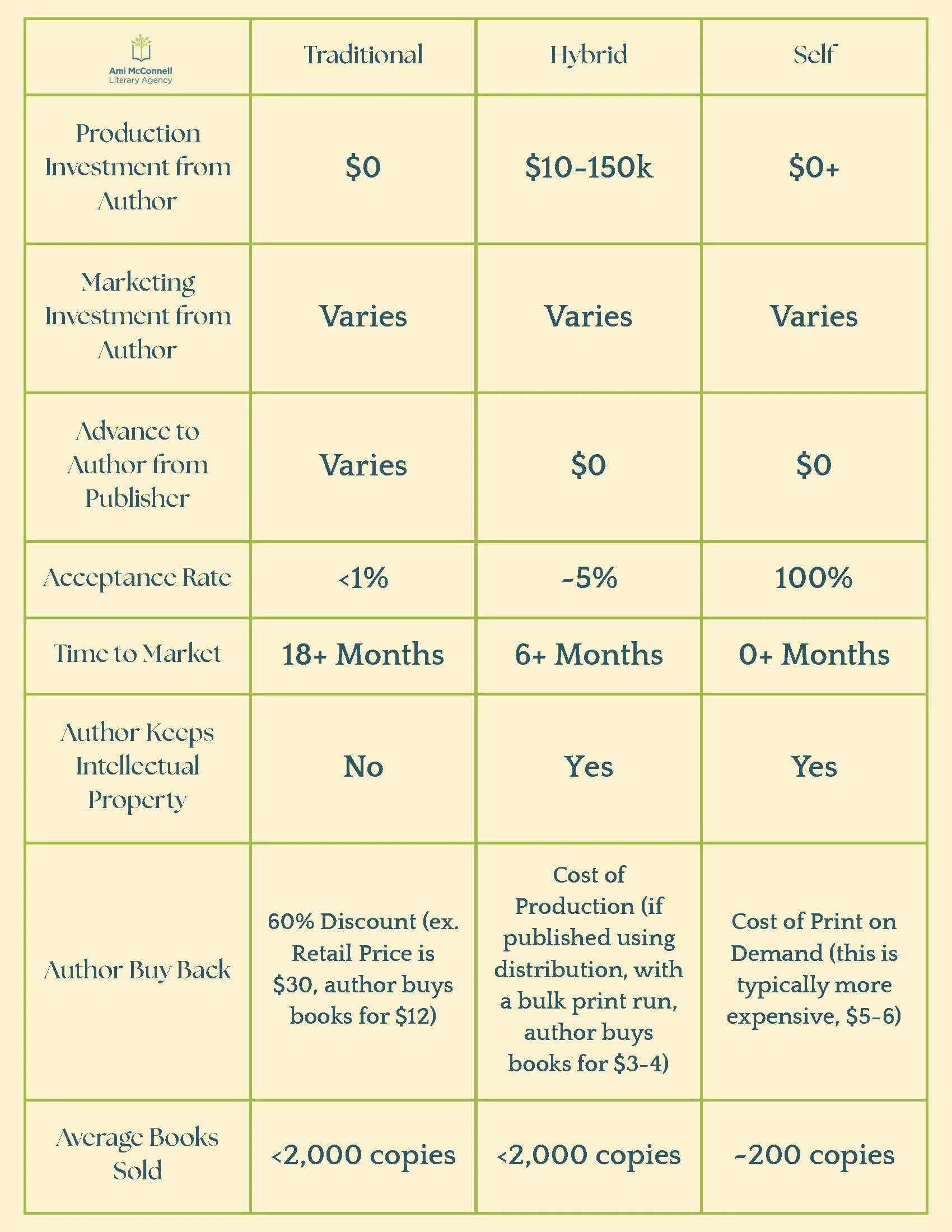
The publishing company (Simon & Schuster, Penguin Random House, etc.) both finances and produces the book in a traditional book publishing deal. A literary agent (necessary for traditional book deals) negotiates with the company toward the terms of the agreement. However, having a literary agent is not a guarantee that an author will receive an offer of publication.. It’s an incredibly competitive market with <1% of submitted books being accepted by a traditional publisher. This method of publication also takes the longest amount of time, with production lasting approximately 18+ months. And if you want to sell your book directly to readers, either at a speaking engagement or on tour, you must buy your books from the publisher at around a 60% discount.
In traditional publishing agreements, the publisher controls the intellectual property. Authors have little control of who or how subrights are exercised.
Many people assume there is significant money to be made with a traditional book deal, and from the outset, that does appear to be the case. Traditional publishing does not assume author investment in the material property of the books.
But it’s important to note that advance an author receives upfront from the publishing company is an advance against future royalty earnings. Once the publisher sells enough books to recoup their investment —or “earn out” the advance— only then or any royalty payments issued to the author. Most traditionally published books sell less than 2,000 copies. 80% of books do not earn out their advance.
If you’re in the lucky 20% and earn out your advance, you’ll be earning 10-15% of net, depending on the format of the book (ebook, paperback, hardcover, audio). The literary agent is getting 15% of that cut. The publisher as investor, keeps around 80% of the upside.
There are real advantages to traditional publishing. A team of professionals designs, edits, and markets their books. Traditionally published books are eligible for book awards and best seller lists that may increase sales. You could get a movie or TV deal, or could sell the rights internationally if it sells well in the U.S. These are not impossible with hybrid or self-options, but they are less likely.
2 - Self-Publishing:
At the opposite end of the publishing spectrum, the author both finances and produces the book. There’s a 100% acceptance rate, the author gets to keep all intellectual property rights, control the timeline, and keep 100% of the profit.
To create a professional product, self-publishers hire contractors to help design an appealing cover, typeset, proofread, and market the book. So, contrary to popular belief, self-publishing is not free.
Some authors choose to do all those things, becoming a subject matter expert. Others contend that’s time better spent writing more books.
Something else to note, if you’re self-publishing, your book is not likely to be sold in bookstores. Self-publishers use a model called “print-on-demand," which means each book is printed as a one-off whenever a physical copy is ordered. Otherwise, it exists online as an ebook. It’s a lower quality product than what would be printed and distributed by the publisher. So to place and sell physical books at your local coffee shop, self-published authors purchase the books at cost. The price per unit is higher than if the books were printed in bulk.
Around 3.5 million books are self-published in the United States every year. Once a book is self-published, it doesn’t go out of print like a traditionally published book might. It exists online forever, or until it’s taken down by the author. So on average, self-published books sell about 200 copies each! It’s a crowded marketplace.
And with AI on the rise, the number of self-published books is likely to rise and it’ll be even harder for good works written by good humans to get noticed.
But self-published books do get noticed as Allen Levi’s Theo of Golden beautifully demonstrates. It was originally self-published but was so popular it was picked up by a traditional publisher. Sometimes that’s not the right choice for the author. They’d rather continue self-publishing, knowing that their books have found an appreciative audience. It takes a lot of work and dedication, but it can be done, and is surely no less rewarding than a big contract deal with a traditional publisher.
3 - Hybrid Publishing:
Hybrid publishing is a blend of self and traditional publishing. In the hybrid model, the author is financing the book and the publisher is producing it. Essentially, the author is fronting the cost of production. The author keeps their intellectual property, a majority of the royalties, and depending on the deal, has a team. It’s selective with about a 5% acceptance rate. The highest barrier to entry is the price.
Hybrid publishing is newer to the publishing world and as such, there are multiple different kinds. The best place to look for information on what is and isn’t hybrid publishing is the Independent Book Publisher’s Association.
Hybrid options vary. An author could pay anywhere from $10k-$150k or more. On the less expensive end of the spectrum, hybrid publishers offer a professional production team including editors, cover designers, typesetters, proofreaders, etc.. Frequently hybrid publishers use a “print on demand” model. Expect a professional experience and product with hybrid publishers.
For a greater investment, you can also get broad distribution. If you go this route and want to purchase copies to sell directly to readers for instance at speaking engagement, you purchase the book from the publisher at cost. Books printed in bulk are cheaper than print-on-demand and often are higher quality products. Hybrid published titles are eligible for awards and bestseller lists unlike self-published works.
Hybrid publishers typically need between 6-9 months to bring books to market, Historically hybrid has been a great option for nonfiction books. As an example, an executive coach might hybrid publish a self-help book toward gaining more business, increasing pricing, public speaking, etc.
Hybrid isn’t exclusively for non-fiction though. Many hybrid companies publish fiction.
Some hybrid publishers offer a profit-share, as we do with our imprints, Abston Books, Banana Banana Books, and Betty Fay Books. We do this in lieu of a royalty advance. Your investment helps offset the costs of our extensive PR and marketing support while keeping the price of production down, making the option to publish is more accessible. (Most hybrid publishers offer zero marketing support.)
What does hybrid publishing cost?

Adult Nonfiction

Adult & Young Adult Fiction
Picture Books and Children’s Books Through Middle Grade
Every author receives:
Professional editing and production
Custom cover and interior design
Industry review submissions
Custom publicity campaign, including strategic launch guidance
NetGalley distribution
Swag design and limited print run
60% royalties on net sales from day one
We offer two publishing pathways depending on the goals, visibility, and platform of each project. See below for details.
We are intentionally boutique. We take on a limited number of titles each year in order to:
Maintain quality
Protect the author experience
Provide personalized strategic support
Build books with long-term potential
We believe publishing works best as a partnership—one where both the author and publishing team are invested in the success of the work.
Whether you’re preparing to publish your first book or expanding an existing platform, our hybrid publishing imprints offer a professional, relationship-driven path to publication.
Our Imprints’ Authors Have Been Featured In


The Standard Publishing Package Includes:
All production coordination
Copyediting + proofreading
Custom cover design
Interior formatting (print and ebook)
ISBN registration + copyright setup
Print proof management
Industry/trade review submissions
NetGalley listing (3 months with option to scale up)
Swag printing package (design and limited print run)
Strategic launch guidance
Marketing + PR consultation
Custom publicity campaign plan and outreach (up to 20 curated outlets)
60% royalties on net sales from day one
$20,000

The Premium Publishing Package Includes Everything in Standard, Plus:
Full audiobook production
Dedicated expanded publicity campaign
Strategic positioning support
Priority production timeline
Enhanced launch coordination for more than one event
$30,000
Get In Touch
“Working with Betty Fay Books was the best decision I made for my novel. This small and dedicated team not only knows this industry but also knows how to make authors feel empowered. Their kindness, professionalism, and expertise is just what every author needs. I couldn’t have become a published author without Betty Fay Books!”
If you're interested in working with us, complete the form with a few details about your project. We'll review your message and get back to you within 1 week.